Six Life Fitness lines cover the whole strength zone — Insignia, Axiom, Plate Loaded, Cable Motion, PWR Play and SYNRGY. Where the heaviest lifting is done, Hammer Strength takes over, from the same house. Every movement comes from the company's own biomechanical research, not from copying someone else's machine.
People don't look for “strength equipment” — they look for a place to press, a place to squat and a place to train their back. So we arrange the zone twice: by Life Fitness line, and by type of machine — where Hammer Strength naturally follows on from Life Fitness.
Life Fitness carries the range — six lines plus benches and frames.
The top selectorized line. Presses and pulls use the Dual Axis design — the arms can converge and diverge during the movement, not just slide along a straight line. For clubs where the strength zone has to look as good as it works.
The same Life Fitness movement on a smaller footprint per machine. For spaces where every square metre has to earn its keep — hotel gyms, office buildings, smaller clubs.
Twelve plate-loaded machines, a Smith Machine and a Smith Rack, formerly Signature Series. Plate training with softer lines and a finer finish — hard training without the hard look.
Cable stations with adjustable pulleys. The member chooses the path, not the machine — so one station covers what would otherwise take five.
Cable and functional training built around a single column. Each Core takes up to four stations, and Cores connect together — from a hotel gym to an entire cable zone.
A multifunctional station that brings together cable training, Olympic lifting, grips, ropes and bags in one place — plus storage for everything that would otherwise roll around the floor. Against the wall or in the middle of the gym, from a single bay to an entire wall.
Flat, incline and adjustable benches, dumbbell and plate racks, Smith Machine, racks and floor platforms. The part that keeps the zone tidy even after the worst afternoon.
Frame and upholstery colours are chosen separately for each line — colour chart →
Nine groups, Life Fitness and Hammer Strength together.
The weight is selected with a pin and the path is fixed. The quickest way into strength training for a member who is just starting, and the safest choice for a gym without constant trainer supervision.
The bridge between machines and free weights. The arms work independently, the load is added with plates, and the feel is closer to a barbell than to any guided machine. Life Fitness Plate Loaded for gyms that want a finer finish, Hammer Strength for those that want it more rugged.
A multifunctional station that brings together cable training, Olympic lifting, grips, ropes and bags in one place — plus storage for everything that would otherwise roll around the floor. Against the wall or in the middle of the gym, from a single bay to an entire wall.
One station, hundreds of exercises. Rotation, pressing, pulling and everything that cannot be done on a fixed path — using the fewest square metres per exercise.
The heart of the free-weight zone. Squat, press, deadlift and Olympic lifts, with bar and plate storage within the frame itself. A rig for the whole zone, with cable stations alongside.
The place where the bar is allowed to drop. A wooden zone for the feet, rubber strips for the plates and a reinforced base — it protects the floor, absorbs impact, dampens noise and clearly marks out the lifting area.
Flat, incline and adjustable benches, racks for dumbbells, kettlebells and plates, and the wall-mounted HD Perimeter system. The part that keeps the zone looking tidy even after the worst afternoon.
A non-motorised sprint treadmill, an air bike, a sled and a rower — the conditioning side of the strength zone, built to take team training rather than an individual. This is Hammer Strength territory.
Handles, ropes, straps, grips and attachments. What decides whether the same machine is used for three exercises or fifteen.
Treadmills, cross-trainers, bikes, Arc Trainer, stair climbers and rowers — the whole Life Fitness cardio range, with Symbio at the top.

Life Fitness and Hammer Strength share the same engineering school, but they don't do the same job in the gym. Hammer is the brand chosen by sports clubs and performance centres — plate loaded and Ground Base machines, the Select and MTS lines, racks, platforms and HD Performance Trainers. It has its own page; here is why it exists at all.
Hammer Strength page →That is the rule Gary Jones laid down in 1989, and Hammer Strength still works by it today. He developed the machines with Cincinnati Bengals players, with one idea: let the machine move the way the body moves, not the other way round. Out of that came Iso-Lateral technology — the foundation of the whole brand and the reason the same exercise feels different on a Hammer.
The handles move independently, so the stronger side cannot do the work of the weaker one. The left-right difference comes to light and evens out over time.
The arms move together or apart during the movement, as in a natural press and pull. There is no straight, fixed line imposing someone else's arc on the body.
The load is added with plates, so resistance throughout the movement is closer to the feel of a barbell. For the member who has outgrown guided machines but is not yet ready for free weights.
Jammer, Combo Twist, Squat/High Pull and Multi-Squat are used from a standing position, fully braced against the ground — because in sport, force is generated from the feet up, not from a seat. Designed in the nineties, and still without a real replacement.
From a rear deltoid machine in 1992 to a standing push/pull machine in 2000 — all in Gary Jones's name. In 2026 Life Fitness named its new development centre after him and Augie Nieto.
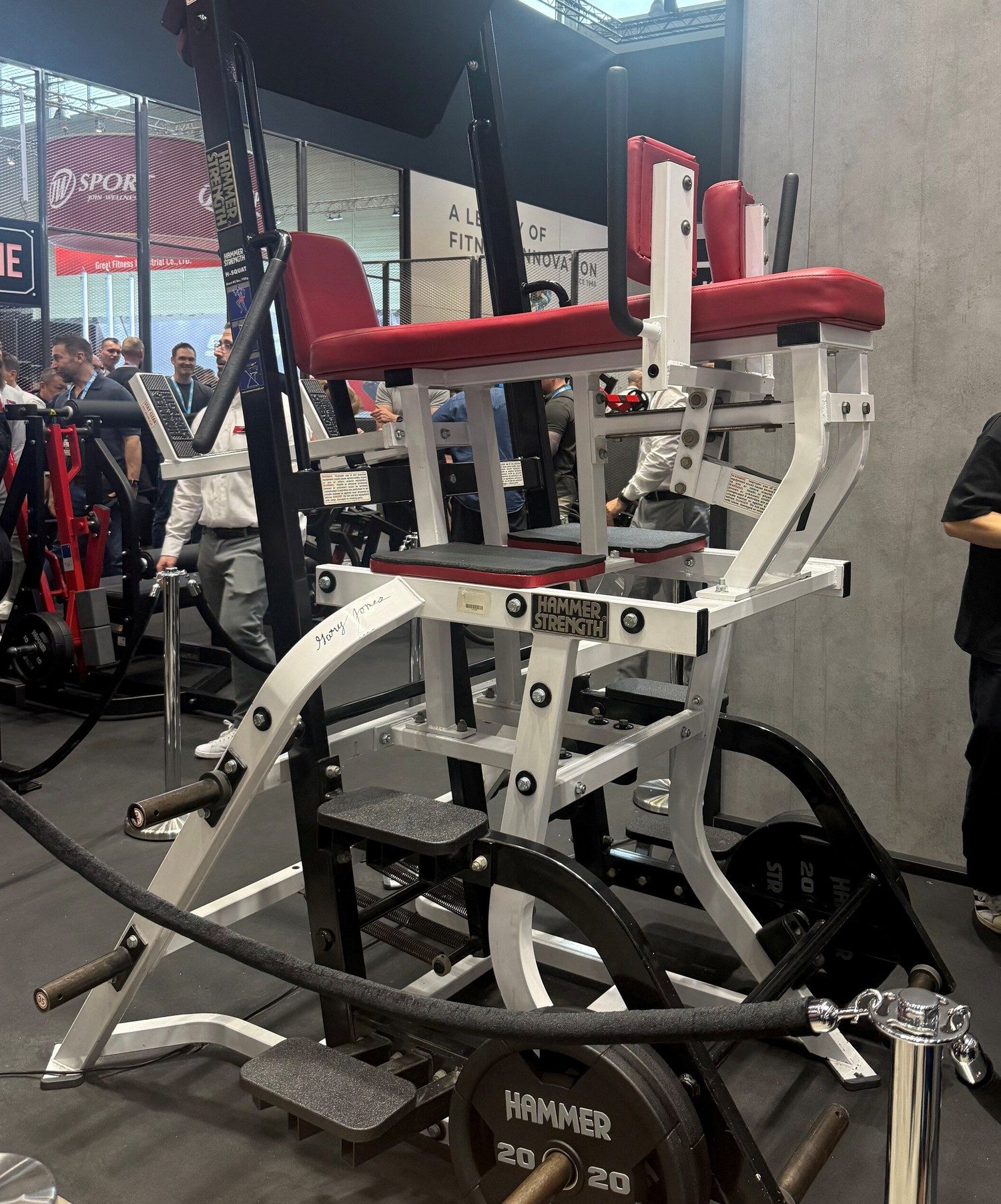
For the last few years the busiest and most photographed part of the gym. Hammer Strength covers it with seven machines that together work the whole posterior chain — from hip thrusts to eccentric hamstring work. Placed together, with their own lighting and signage, they become the reason someone chooses your gym.
Hip thrusts with repeatable technique and high muscle tension. No setting up — lean back, load and go. The foot platform has a non-slip surface and is angled at 15° for correct heel position.
The load goes through a belt around the hips, not through a bar on the back. Full lower-body loading without pressure on the spine.
A guided squat for heavy loads and targeted glute activation, with the back supported throughout the movement.
A deep squat in which the load stays constant along the whole path — with no easier or harder point.
Squat variations for different heights and goals. Loading from above gives a descending load profile, from below an ascending one.
A squat facing the machine, braced at the shoulders, on an angled path that keeps the glutes under load through the full range of motion.
Assisted eccentric hamstring work — for strength, control and prevention of knee and hamstring injuries.
Hammer Strength makes racks at two levels. The difference is not in the look but in the steel — and in what is expected of the frame.
Racks for places where training is serious and frequent. 4×3-inch uprights in 7-gauge steel — the wall is 50% thicker than 11-gauge. A walk-through frame, a huge choice of attachments and storage, and the option of having your logo and your colour on the rack.
A modular system configured to the space, not the other way round. 3×3-inch uprights in 11-gauge steel, 218 or 231 cm high — the lower version fits under a standard two-and-a-half-metre ceiling. For school gyms, clubs and facilities that build the zone in phases.
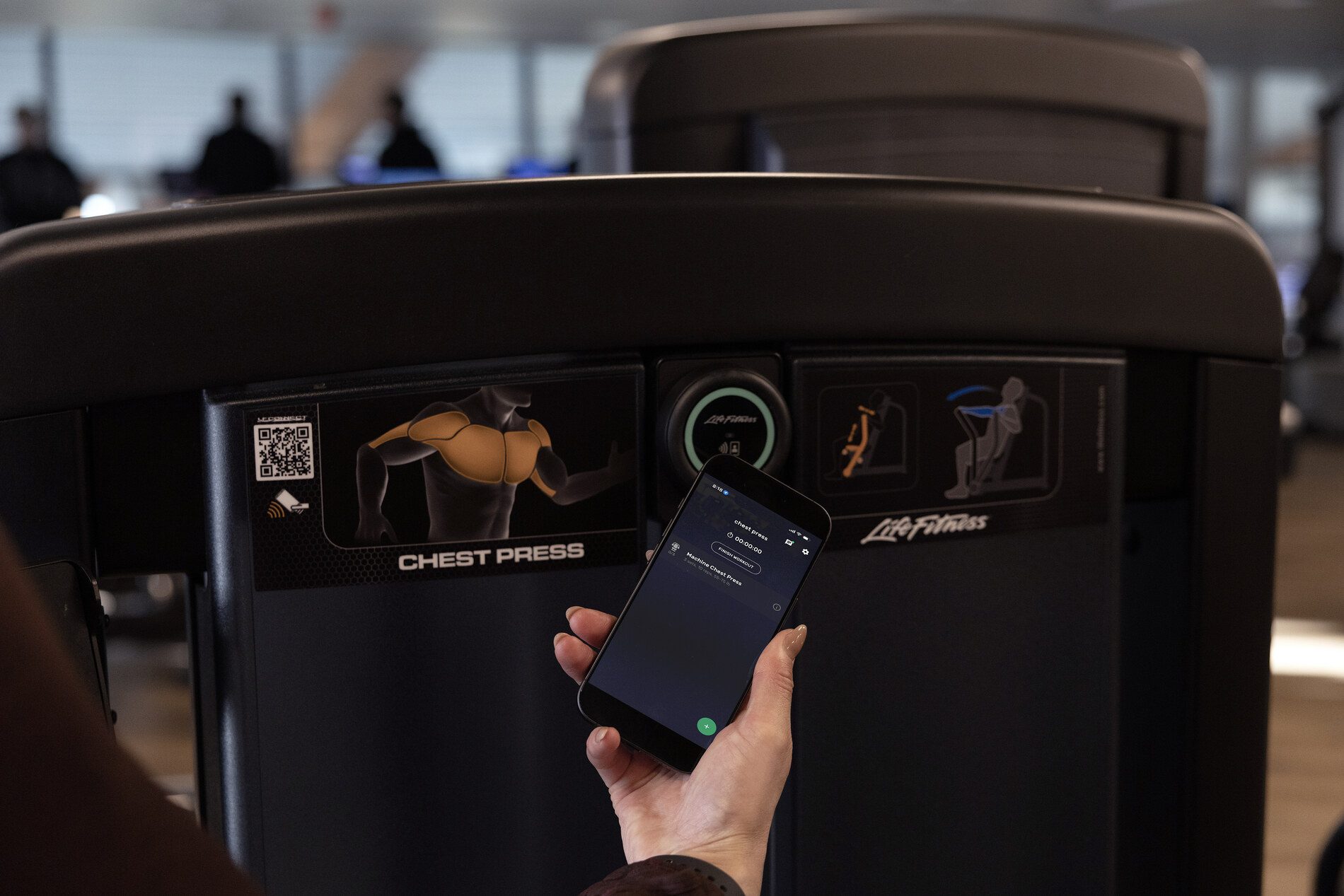
Cardio has long recorded itself. Strength stayed invisible for decades — nobody knew how much each machine was used or what a member had actually done. Connect Kit changes that.
The module can be added to both new and existing machines. The member taps their phone, does a set and it is logged — no typing and no paper.
It runs on a long-life battery. No running services across the strength-zone floor and no modifying existing machines.
At last you can see which machine is used, how much and when — so the next purchase and the gym layout are planned on numbers, not impressions.
The workout follows the member from the treadmill to the strength machines and back, in the same app. The programme their trainer put together is waiting for them at the machine.
An overview of the whole facility: equipment status, utilisation, updates and service requests in one place, and for several locations at once.
The same equipment in two spaces gives two completely different results. The difference is in who laid it out, who connected it and who maintains it.
An AutoCAD floor plan and a 3D render of the zone before you sign anything — how many machines fit, where the walkways are and how much space each rack needs.
Platforms, rubber flooring and wall systems are part of the same project. A strength zone needs floor load capacity and the right surface, not just machines.
Hammer Strength certifies its equipment to ASTM and EN standards, then exceeds them in its own laboratory by up to ten times.
New Life Fitness and Hammer Strength machines in Croatia are available exclusively through us — with the full manufacturer's warranty and original parts.
Our own technicians based inland and on the coast, typically on site within 24 – 48 hours, and a maintenance contract for facilities that run continuously.
The zone is built in phases. Modular racks, accessories and Connect Kit are added to what is there without replacing what you already have.
Send us the floor plan or the dimensions. After a conversation we put together a quote for the strength zone, listing the equipment by category, and an indicative price.
Request a quote