
Everything in a gym stands on it, and every member is in contact with it the whole time. Yet it is chosen last and by price per square metre — which is why the first complaints are about it. Pavigym has been making gym flooring, zone by zone, for over sixty years.
On the floor plan the floor looks like a single figure: area times price. In the gym it is the surface every member touches every minute, on which every machine stands and through which every sound travels into the building.
No floor does everything. A floor that takes a dropped bar is too hard for group classes. One that is comfortable for yoga shifts under a treadmill. That is why Pavigym sells not one floor but families, chosen by zone — not by facility.
This is the first decision and the one that changes the price most. Virgin rubber is pure rubber that has never been reprocessed — Pavigym uses it in the Prime family. Recycled rubber comes from reprocessing and makes up the Core family. Both are serious floors, but they behave differently under load, age differently and look different after five years.
The highest standard in the range. Prime Tech is Pavigym's own pure-rubber formulation, developed for durability, dimensional stability and low porosity. For facilities where the floor has to take the most and still look as intended years later.
Core Tech is Pavigym's controlled recycled-rubber technology — developed to lift recycled rubber above commodity level through durability, dimensional stability and a consistent appearance. For large areas at a sensible price per square metre.
Pure rubber absorbs less. Sweat and dirt stay on the surface instead of getting into the material, so the floor is easier to clean and does not change its smell over time.
Recycled rubber is essentially black, and colour is added with granules. Virgin rubber is coloured throughout, so the tones are clean and repeatable — important when zones are separated by colour or an exact RAL shade is required.
A rack or machine stands on a small area and presses on the same spot all the time. The Prime formulation keeps its shape and thickness, so there are no dents and no shifting joints.
This is the part we settle before a single metre is ordered. A zone is chosen not by how it looks but by what falls, stands and is dragged on it.
The machine has to stand still and the floor has to take a constant load on a small area. Endurance or Extreme, depending on use.
7 – 22 mmThis is where the bar gets dropped. Thick layers and acoustic tiles, because otherwise the impact is transmitted to the structure.
22 – 90 mmA treadmill must not move a millimetre. An anti-slip tile or roll that holds the machine in place and makes cleaning easier.
6 – 11 mm16 mm turf, with a density of up to 84,000 stitches per square metre. Plain, sprint or HRX pattern, in rolls up to 20.6 m long.
16 mm + 8 mm underlayMotion — point elasticity and grip tuned for jumping and quick changes of direction in a room full of people.
9 mmFloor work and barefoot training. EVA foam mats, free of latex and PVC, in several thicknesses.
5 – 15 mmTraffic vinyl with the iGuard protective layer, waterproof, in wood or stone finishes. Glued or with the Clic system for fast installation.
2.5 mm · 5+1 mmOptifoam, Impulse and Underlay+Silent. The part you don't see, but which decides whether the gym will be heard in the rest of the building.
5 – 30 mmIn a hotel it is the guest in the room below. In a residential building, the neighbour. In an office building, the meeting one floor down. Impact noise is the only reason gyms get closed after opening — and the only one that can be solved solely before installation.
The dB(A) values show how much the peak sound level falls when a 50 kg weight is dropped from 50 cm, measured to EN ISO 10140-3. The data come from Pavigym's technical data sheets of June 2026; for a specific building, an on-site measurement is what counts.
This is the part that makes a gym look like a project in photographs rather than a warehouse of machines — and the cheapest way to set a space apart from the competition.
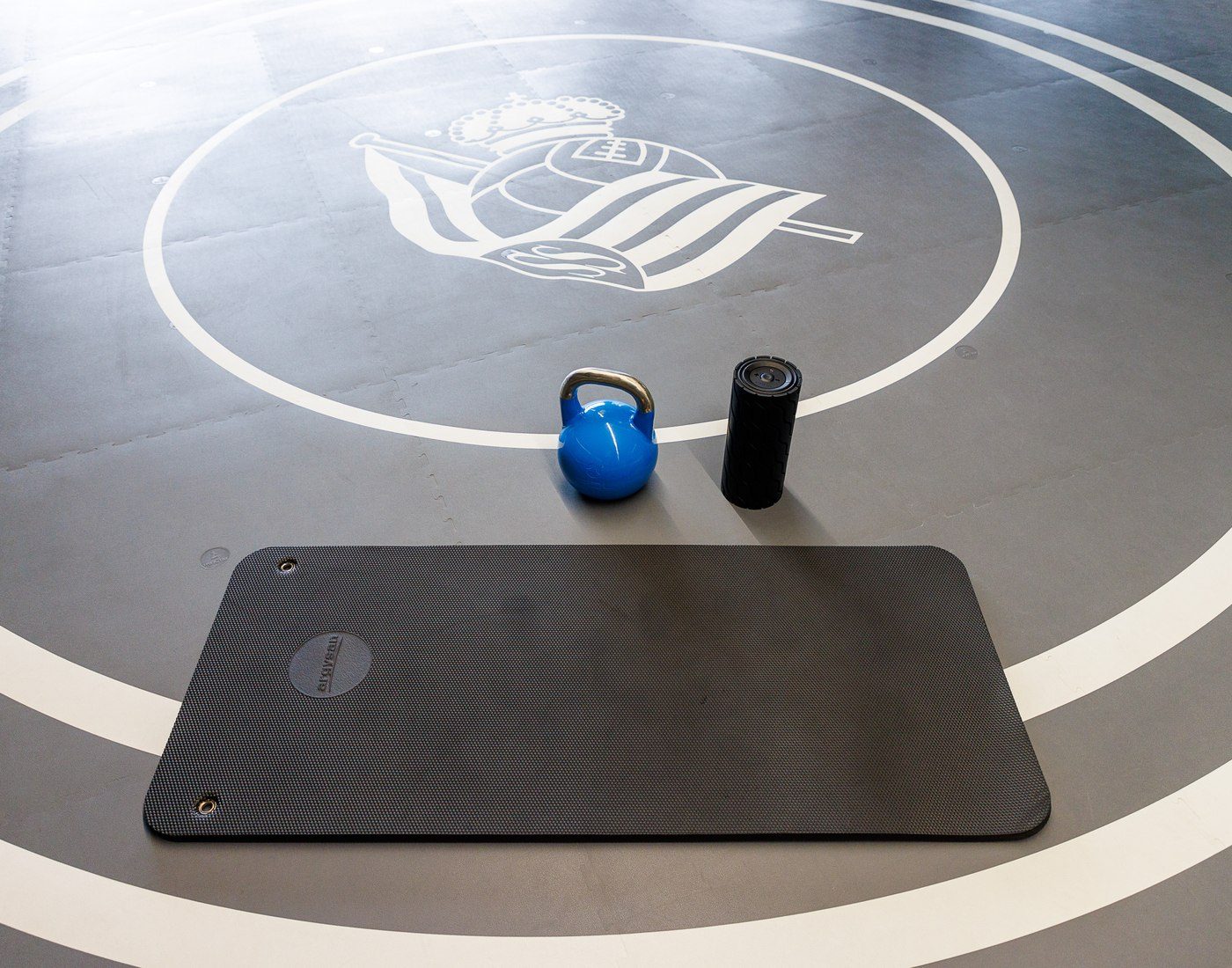
Colours are chosen from the RAL and Pantone ranges, so zones are separated by colour instead of partitions. The facility's logo, lane numbers and exercise markings are printed into the floor itself, not stuck on afterwards.
On turf you choose the pattern — plain, sprint with lines, or HRX. The sled track gets its own graphics and becomes a recognisable part of the gym, not just a strip in a different colour.
The same approach works in a hotel: Traffic in a wood finish in the corridor, dark rubber in the strength zone and green turf on the track — all from one source, so the materials work together instead of clashing.
Twenty-four rubber tones from the 2026 colour catalogue: twenty-one in the Prime family and three in Core, plus five colours for markings. Traffic comes in four wood finishes and three stone finishes, and turf in green and black. Not every colour is available on every product, so the breakdown by product is in the flooring catalogue. For special requirements, colour is matched to the RAL or Pantone range. What you see on a screen is never accurate — we bring samples for you to see.
A ten-centimetre sample looks the same from everyone. The difference only shows over five hundred square metres and after three years of use.
The tiles join without adhesive and hold together like a jigsaw. The surface stays practically seamless, with no joints for water and dirt to get into.
A surface treated so that less sticks to it and it cleans more easily. Lower maintenance cost over the whole life of the floor.
Additional protection against flame spread, when the project or the building requires it. Chosen by class under EN 13501-1.
Power and network cabling run through the floor itself. Machines in the middle of the gym get power without floor ducts or trailing cables.
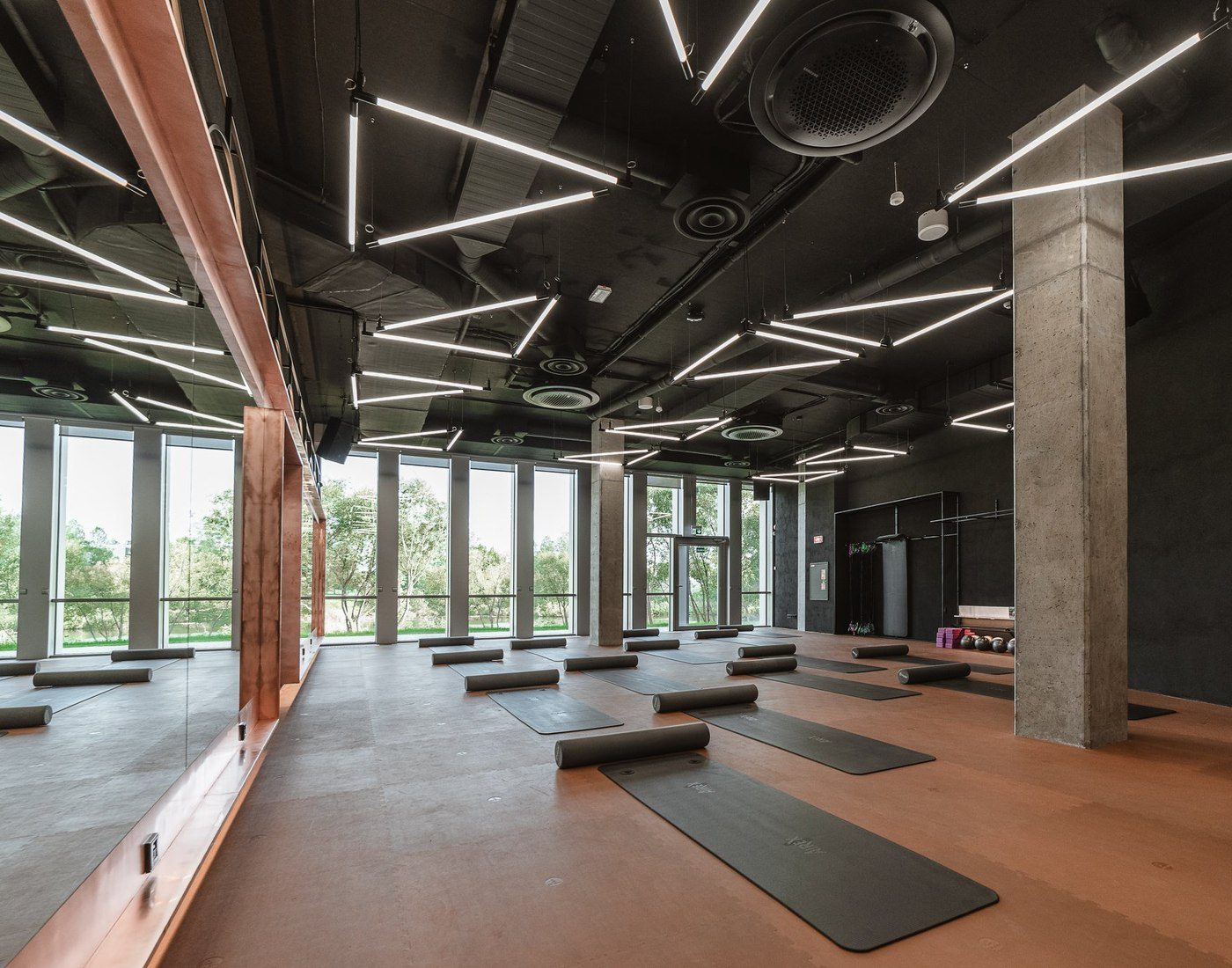
A facility rarely has just one zone. When the floors come from three different suppliers, the heights differ, the transitions are fixed with strips and in the end nobody is responsible for anything.
When they come from one manufacturer, the heights are planned in advance, the transitions are drawn on the floor plan, and there is one warranty. That is why we treat Pavigym as a supplier in its own right, not as an add-on to the machines.
We do not sell flooring by the square metre over the phone. It goes into the same drawing as the machines, because it determines where a machine may stand at all.
Zones, colours and transitions are visible in the visualisation before ordering. Floor graphics are drawn together with the equipment layout.
The flatness, moisture and load capacity of the existing floor are measured before the choice is made. That determines whether the floor will be glued or loose-laid.
Cutting, joining and transitions between zones. Interlocking without adhesive, or glued, depending on the build-up.
If there is a room, office or apartment below the gym, the underlay is chosen at the start. After opening, this can no longer be fixed cheaply.
Samples for inspection and matching to the facility's colours, including a logo in the floor.
Flooring, machines and installation go through the same quote and the same installation date.
Those two answers are where the conversation starts. If you have a floor plan, send it — after a conversation we put together a flooring proposal by zone, with colours and thicknesses.
Upper floor, basement or ground floor, and what is in the room below. That is where choosing a floor starts — everything else is easier.
Request a quote